


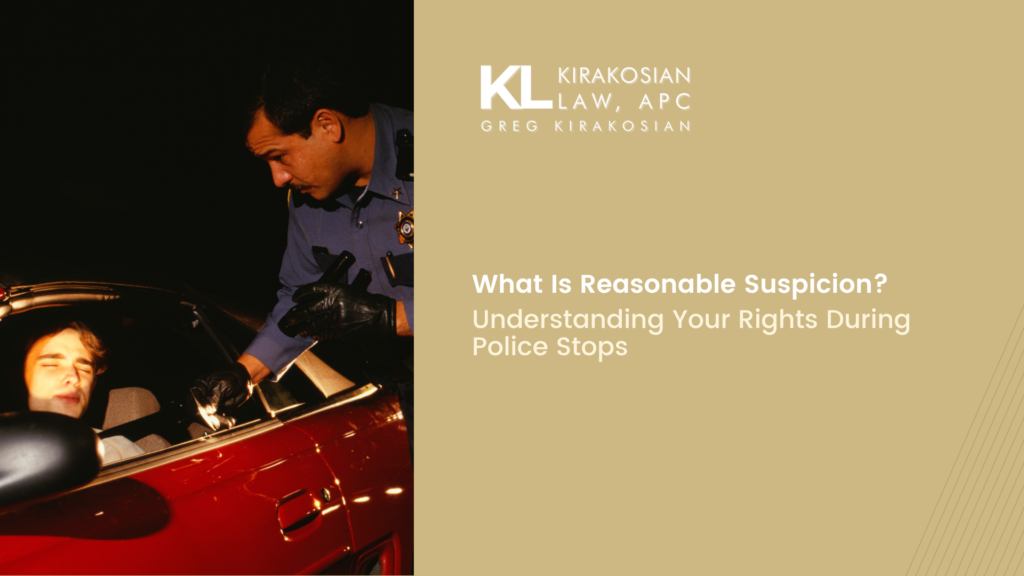
Reasonable suspicion is the legal standard that allows a police officer to briefly stop and question you, based on specific, articulable facts suggesting that criminal activity may be occurring. It requires more than a hunch or a feeling, but it is a lower bar than what’s needed to arrest or fully search someone. Knowing where that line falls, and what belongs on each side of it, can make the difference between a lawful stop and a civil rights violation. For anyone who has ever been pulled over, stopped on the street, or questioned by police in Los Angeles without understanding why, this distinction is not academic. It determines whether that encounter was lawful in the first place.


Reasonable Suspicion vs. Probable Cause
These two standards are often confused, but they are legally distinct and control different police actions. Reasonable suspicion, established in Terry v. Ohio (1968), permits a brief investigative stop and, if the officer reasonably believes you are armed, a limited pat-down for weapons. Probable cause is a higher standard, requiring enough reliable facts and circumstances to justify an arrest or a full search. An officer can lawfully stop you on reasonable suspicion alone, but generally cannot arrest you or search your belongings without first developing probable cause.
Examples of Lawful and Unlawful Stops
A stop is generally lawful when it is based on specific facts: you match the detailed description of a suspect fleeing a nearby crime, an officer personally observes a traffic violation, or your behavior, not your presence alone, suggests criminal activity is underway. A stop becomes unlawful when it rests on a generalized hunch, presence in a “high-crime area” without anything more, or profiling based on race, dress, or association rather than specific, articulable facts about you. Courts have also found stops unlawful when an officer relies on a description so vague, such as “a man in dark clothing” in a busy area, that it could apply to almost anyone nearby.
The setting matters too. A stop that starts as a lawful, brief encounter can turn unlawful if it drags on well past the time needed to confirm or dispel the officer’s suspicion, or if officers use it as a pretext to search for unrelated evidence. California courts scrutinize these extended stops closely, since the reasonable suspicion that justified the initial stop does not automatically justify everything that follows it.


How Courts Evaluate Reasonable Suspicion
Courts apply a “totality of the circumstances” test, weighing everything the officer knew at the moment of the stop, including their training and experience. But that training and experience must connect to objective facts. Courts have repeatedly rejected stops built on vague impressions dressed up as expertise. If the specific facts cannot be articulated clearly after the fact, the stop likely will not hold up. Judges also look at the sequence of events: what the officer observed first, what that observation reasonably suggested, and whether each additional step of the encounter was still supported by the facts known at that moment.
When Legal Action May Be Appropriate
If a stop escalated into a prolonged detention, search, or arrest without ever reaching the reasonable suspicion or probable cause required at each stage, you may have both a criminal defense against any resulting charges and a separate civil rights claim for the stop itself. This is especially true where the stop appears to be based on your race, neighborhood, or appearance rather than specific facts about your conduct.
Knowing your rights during a stop does not mean resisting or arguing with an officer in the moment. It means staying calm, being clear that you do not consent to any search beyond what the officer is legally permitted to conduct, and remembering as many details as possible to share with an attorney afterward. The strength of a later civil rights claim often depends on exactly what was said and observed in those first few minutes.
If you believe you were stopped, detained, or searched in Los Angeles without reasonable suspicion, Kirakosian Law can review what happened and explain your legal options. Contact us for a free, confidential case review. There is no fee unless we win.