


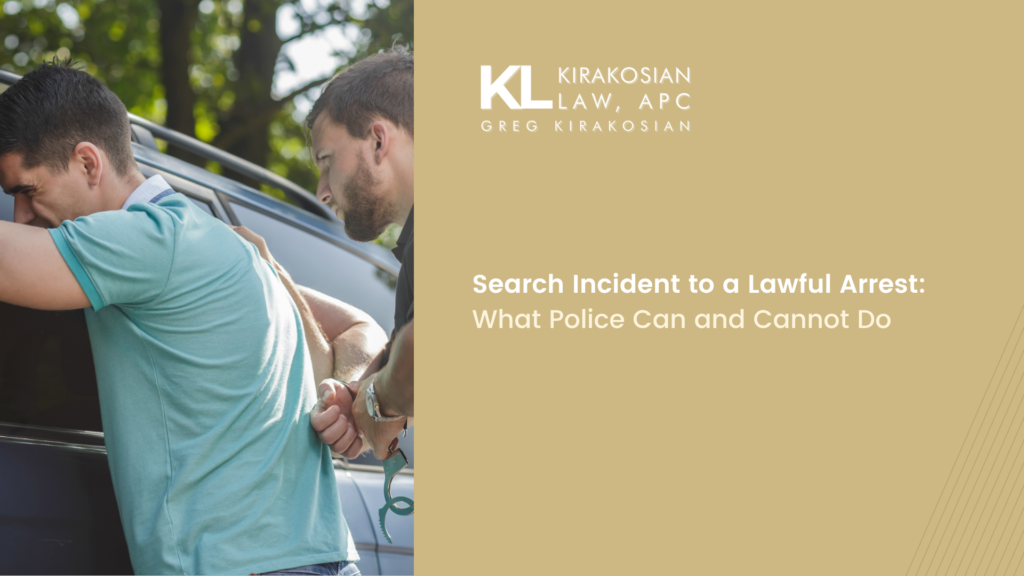
A search incident to a lawful arrest is one of the few exceptions that allows police to search you without a warrant. When an officer makes a valid arrest, the law allows them to immediately search your person and the area within your immediate control, without first getting a warrant or your consent. It is one of the most commonly used, and most commonly misapplied, search exceptions in California policing. Even during a lawful arrest, your constitutional protections do not disappear. They simply narrow to a defined scope, and that scope is exactly where most disputes over these searches begin.


Why This Exception Exists
The Supreme Court established this exception in Chimel v. California (1969) for two narrow reasons: officer safety and the preservation of evidence. An officer making an arrest needs to be able to check for weapons the person might reach, and to prevent the destruction of evidence that could be hidden or destroyed in the moments after an arrest. The exception was never meant to serve as a general license to search everything connected to a person. It covers only what is within their immediate reach at the moment of arrest.
What Police Can Search
Under this exception, officers can search your person, your clothing, and any area within your “wingspan,” meaning the space you could reach to grab a weapon or destroy evidence. That can include pockets, a jacket, or a bag you are carrying at the moment of arrest. For vehicle stops, the Supreme Court narrowed this further in Arizona v. Gant (2009): police may search a vehicle’s passenger compartment only if the arrestee is unsecured and within reaching distance of the vehicle at the time of the search, or if officers have a reasonable belief that evidence relevant to the crime of arrest is inside the vehicle. Outside of those two situations, officers generally need a warrant or a separate exception, such as consent or the plain view doctrine, to search a vehicle after an arrest.
It’s also worth noting that a search incident to arrest is limited to that single encounter. It does not give officers standing authority to return later, re-search the same area, or search additional locations connected to you without independently satisfying the Fourth Amendment. Each search must be justified on its own, at the time it happens.
What Police Cannot Do
What officers cannot do is treat an arrest as a blanket excuse to search anywhere they choose. A lawful arrest on the street does not automatically justify a search of your home. Officers cannot search a locked trunk or a secured vehicle once you are handcuffed and no longer near it, unless the Gant exception applies. And critically, if the underlying arrest itself was not lawful, made without probable cause, everything found during the “search incident to arrest” can be challenged along with the arrest itself.


Common Examples
We regularly see this play out in a few recurring settings across Los Angeles. A driver is arrested during a traffic stop and officers search the entire vehicle, including the trunk or areas the driver could not possibly reach. Someone is arrested at their front door and officers use that arrest as a springboard to search deeper into the home without a warrant. Or a person is handcuffed and placed in a patrol car, yet officers still search the vehicle minutes later even though the person can no longer reach it and there is no reasonable belief evidence is inside. Each of these scenarios pushes well beyond what Chimel and Gant actually permit, and each is the kind of fact pattern our attorneys look for when reviewing an arrest.
When a Search May Become Unlawful
A search incident to arrest becomes unlawful when it exceeds the permitted physical scope, when it happens long after the arrestee has been secured and removed from the area, or when the underlying arrest itself lacked probable cause. Any of these can make evidence subject to suppression in a criminal case, and can support a separate civil rights claim.
If you believe a search during your arrest went beyond what the law allows, Kirakosian Law can review the facts of your Los Angeles arrest and explain your options. Contact us for a free, confidential case review.