
A deputy pulled my client over at 3 a.m. for a dark license plate. No ticket. No arrest. Seventeen minutes later he drove away, and a federal judge later ruled those seventeen minutes violated the Constitution. Here is exactly where the line is.
I have spent years suing police officers who cross the line, and one lesson took me a long time to learn: the most important cases do not always look important. This one looked like nothing. A man pulled over because the light over his plate was out. Seventeen minutes. No ticket, no arrest, handed back his license and sent on his way. On paper, nothing happened. But something did, and it is one of the most common ways police quietly cross the line in California. It comes down to one idea: once the reason for the stop is over, the stop is over.
The short answer
An officer who sees a traffic violation can pull you over and deal with it. They can ask for your license, registration, and insurance, and run you for warrants. What most people do not know is what happens next. Once the officer has handled the reason for the stop, they cannot keep you sitting there to ask unrelated questions or fish for other crimes, unless they have specific, independent reasonable suspicion that you are involved in some other crime. Holding you past that point, even by a couple of minutes, is an unlawful seizure under the Fourth Amendment. That is the rule that decided my client’s case.
GREG KIRAKOSIAN’S LEGAL EYE VIEW
I have watched this exact move play out on countless dashcam videos, and here is the part that matters in plain English: the ticket is the whole reason they can hold you, so when the ticket is done, so are they. Everything after that has to be earned with a real, specific reason, not a feeling about the hour or the neighborhood. When I take one of these cases, I am really just building a clock and asking one question: what time did the reason for the stop run out?
What happened: a delivery driver, a dark plate, and 17 minutes
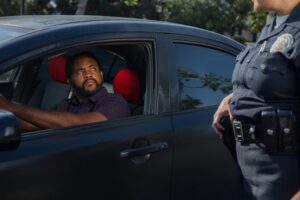
My client, Johnathan Cain, was driving for Uber Eats a little after 3 a.m., his girlfriend in the passenger seat, when a San Bernardino County sheriff’s deputy pulled him over. The plate light was out and there was a question about his registration. That was a lawful stop, and I never disputed it. Johnathan did everything right. He pulled over immediately and handed over his license, insurance, and registration without a problem. The deputy ran him, and nothing that mattered came back: no warrants, not on probation, not on parole. In his own deposition, the deputy admitted that at that moment he had no reason to arrest Johnathan for anything.
That is the moment the stop should have ended. A ticket, a warning, or “have a good night.” Instead the deputy walked back to the window, and his first words were about Johnathan’s past.
“Hey Johnathan. When’s the last time you were in trouble, bro?”
He could not name a single crime he thought Johnathan had committed. His reason, in his own declaration, was a feeling: it was 3 a.m. and he was alone in what he called a high-crime area. Johnathan kept telling the truth, that he was just working. The deputy kept him there anyway. When a second deputy arrived, the body camera caught the real reason Johnathan was still being held: “He was just running his mouth, so I just put him in the car.” No ticket. No tow. No arrest. About seventeen minutes, start to finish, and, as a federal judge later ruled, unconstitutional.
The rule in plain English
Think of a traffic stop like a hall pass. A hall pass is good for one trip and nothing else. A stop is the same. It is good only for the reason it was issued, what the law calls the stop’s “mission”: dealing with the traffic problem, plus the ordinary safety steps that go with it. The officer gets the reasonable time it takes to do that job. Check the license. Check registration and insurance. Run the warrant check. Write the ticket. When the job is done, or reasonably should be, the authority to hold you ends. To go further, the officer needs a fresh, specific reason to believe you are involved in a different crime. A hunch does not count. “It is late and this is a rough area” does not count. “He was talking too much” definitely does not count. The Supreme Court settled that in 1979: being in “a neighborhood frequented by drug users, standing alone, is not a basis for concluding that [a person] himself was engaged in criminal conduct.” Brown v. Texas, 443 U.S. 47, 52 (1979).
The law behind it
The rule comes from the Supreme Court in Rodriguez v. United States (2015). An officer finished a traffic stop, then held the driver a few extra minutes for a drug dog. Those minutes were the whole case. The Court held that a stop “may last no longer than is necessary” to handle its mission, and that authority for the seizure “ends when tasks tied to the traffic infraction are, or reasonably should have been, completed.” 575 U.S. at 354. There is no free grace period. An officer may run unrelated checks during a lawful stop, but “may not do so in a way that prolongs the stop.” Id. at 355. Safety steps get some latitude as “negligibly burdensome precautions,” id. at 356, but only where they are tied to the traffic mission rather than to an investigation the officer had no basis to start. As a federal court in California put it, “an unrelated inquiry that adds any amount of time to a traffic stop is sufficient to violate the Fourth Amendment” (Odom, 588 F. Supp. 3d at 1040). The Ninth Circuit has said it for years: detention beyond the stop “must be supported independently by reasonable suspicion of criminality” (Melendres, 695 F.3d at 1000), and it threw out an arrest built on a prolonged stop in Landeros, on facts close to Johnathan’s.
Why the deputy lost, and why qualified immunity did not save him
Line those up against that night and the pattern is unmistakable: a lawful stop, a completed mission, then extra time taken to fish, with no independent reasonable suspicion. That is the exact move the Constitution forbids. The court granted summary judgment that the prolonged detention was unconstitutional as a matter of law, before any trial, because no reasonable jury could see it another way. The order put the decisive fact bluntly: the deputy “fails to ever identify any particular crime or offense he reasonably suspected [Johnathan] of having committed.” That one sentence is the whole case.
The deputy raised qualified immunity, the defense that protects officers when the law was unsettled. The court rejected it. The test is not whether an earlier case had identical facts; it is whether existing precedent placed the question “beyond debate.” Ashcroft v. al-Kidd, 563 U.S. 731, 741 (2011). By the night of this stop, Rodriguez, Landeros, and Odom had already made the rule clear enough that any reasonable officer would have known it. Once qualified immunity is gone, these cases head toward a jury, and that is what drives departments to resolve them. This one resolved for $295,000, for a stop that lasted about seventeen minutes and ended with no charges at all.
How we proved it: this case was won in a deposition, not a closing argument. Before I sat down with the deputy I already had his body camera, his report, and the dispatch log, so I rebuilt the stop second by second and walked him through it in order. He agreed he pulled Johnathan over for the plate light. He agreed the records check came back clean. He agreed that at that moment he had no reason to arrest anyone. Then I asked the only question that mattered: what new fact, learned after that point, made him suspect Johnathan of a specific crime? He did not have one. That answer, in his own words, is what I moved for summary judgment on.
What an officer can and cannot do
- Can pull you over for any real violation, even a minor one, whatever the officer’s private motive (Whren).
- Can run your license, registration, insurance, and a warrant check. That is the mission.
- Can order you and your passengers out of the car for safety (Mimms).
- Can ask unrelated questions or walk a dog around the car, but only if it does not add time.
- Cannot hold you past the point the ticket is done to chase a hunch, without specific, independent reasonable suspicion.
What to do if it happens to you
- Stay calm, keep your hands visible, and hand over your license, registration, and insurance.
- Ask the one question that matters: “Officer, am I free to go?” It puts the issue on the record.
- You do not have to answer unrelated questions. “I would rather not answer questions” is enough.
- You can decline searches: “I do not consent to any searches.” Saying so is not evidence of guilt.
- Do not physically resist, even if you are sure the stop is unlawful. You win this in court, not on the street.
- Remember the times and what was said, and if it is safe and lawful, record it.
- Watch the calendar afterward. A claim against a California city or county can require a formal government claim within six months, and a federal civil rights claim under 42 U.S.C. § 1983 generally has two years in California. Deadlines vary by claim, so do not wait to ask.