


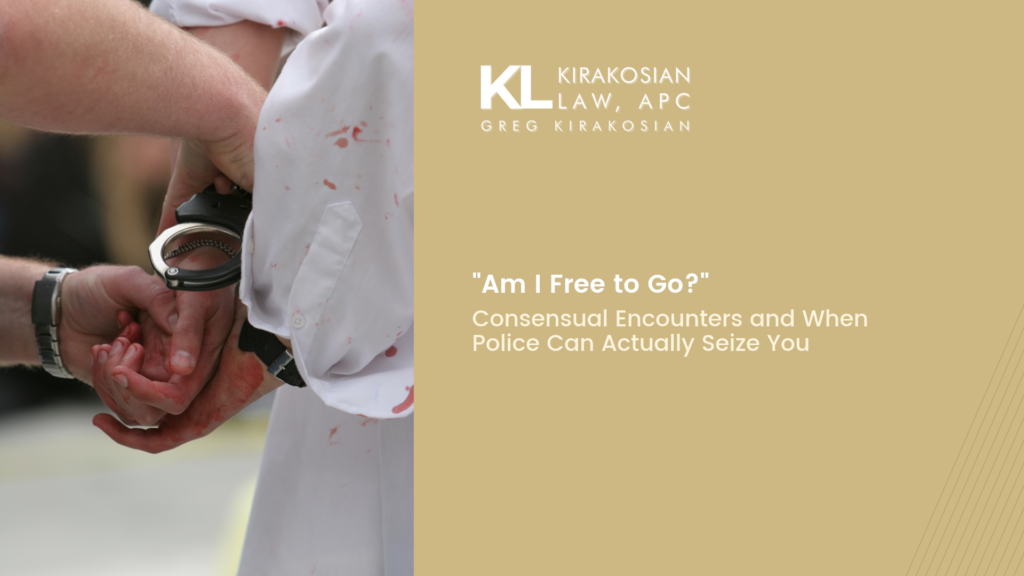
By the deputies’ own testimony, my client was free to go to his room and go to sleep. Then he asked one question, and seconds later he was in handcuffs. No new evidence, no threat, nothing but a question about whether they suspected him of a crime and the answer was a pair of handcuffs. The case resolved for $100,000.
I have spent years suing officers who cross constitutional lines, and one lesson matters more than any other: not every conversation with police carries the same legal weight. Most people, and more than a few officers, blur it all into one idea: “the police are talking to me, so I have to do what they say.” That is not the law, and the difference decided what happened to my client, Sky Miller.
The short answer
The law recognizes three levels of police-citizen contact. A consensual encounter is just a conversation, the officer needs no suspicion at all, and you’re free to decline to answer or walk away. An investigative detention, or Terry stop, is a brief seizure requiring reasonable suspicion of criminal activity. An arrest is a more serious seizure generally requiring probable cause.
Each higher level demands stronger justification than the last. These aren’t mandatory steps an officer must walk through in order police can arrest immediately if probable cause already exists. But an officer cannot turn a consensual encounter into a detention or an arrest just because a person declined to answer, declined to give their name, or asked whether they were free to leave. Exercising those rights cannot, by itself, supply the suspicion or cause the officer is missing.
GREG KIRAKOSIAN’S LEGAL EYE VIEW
Here is what actually matters: the deputies answered the hardest question for me before I ever filed anything. They admitted, under oath, that my client was free to go. That admission does most of the legal work in a case like this, because once you’re free to go, the officer needs a genuinely new fact to take that freedom back, not irritation, not attitude, not a lawful question about their authority. When I build one of these cases, I look for the exact moment “free to go” turned into “you’re under arrest” and ask what changed in between. Usually, as here, the honest answer is nothing.
What happened: from “free to go” to handcuffs
On the night of March 27, 2024, Sky Miller was a guest at the Catalina Canyon Inn in Avalon, on Catalina Island, working through a room-key problem. His girlfriend, who held the reservation, had left after an argument, so the hotel needed her permission to re-key the room. She gave it, and the front desk was preparing a new key. Hotel staff described Sky as “belligerent” and called the Los Angeles County Sheriff’s Department, which polices Avalon under contract but also told the responding deputies that Sky remained a welcome guest.
Deputy A. Evans and Sergeant V. Durante engaged with Sky in the lobby. There was back-and-forth, some of it tense, including talk of jail. Then it de-escalated. Everyone landed on the obvious resolution: Sky would get his key, go to his room, and sleep. The deputies agreed. Deputy Evans had already been handed the key. Sergeant Durante later admitted in his deposition that if Sky had simply been given the key at that point, he would have been free to go and that nothing new happened between that moment and the arrest.
That is the legal turning point. When officers agree you’re free to leave and nothing stops you from going about your business, the encounter is consensual, not a seizure and the deputies had no authority to detain or arrest Sky without new, independent justification. He was free to decline further conversation, decline to identify himself, and go to his room.
Instead of handing over the key, Sergeant Durante demanded Sky’s name. Sky did what a person is generally allowed to do in a consensual encounter: he asked, “Do you have a reasonable, articulable suspicion of a crime?” That was not compliance, but it was not a crime either. Durante answered, “You’re about this close to getting handcuffed.” When Sky started to ask the question again, they arrested him. Within seconds, the deputies moved from an encounter Sky was free to leave to a full arrest, without identifying any new fact that justified the escalation. The only thing that changed was that Sky exercised rights that belong to a consensual encounter.
Sky spent approximately two hours in custody. Officers made comments afterward to the effect of “you ruined it” and “you did it to yourself.” The district attorney declined to file charges.


The rule in plain English
Think of police authority as three levels, each needing a stronger reason than the last. At the first level, a consensual encounter, an officer can approach and ask questions, and you can answer, decline, or leave, no suspicion required, because your freedom isn’t restricted. At the second level, an investigative detention, the officer can briefly hold you, but only with specific, articulable facts creating reasonable suspicion you’re involved in criminal activity. At the third level, an arrest, the officer can take you into custody, but generally only with probable cause.
These levels aren’t always sequential, an officer with probable cause doesn’t need to run through a detention first. But an officer in a consensual conversation cannot escalate it just because a person seems disrespectful, declines to cooperate, or asks the officer to explain their authority. And because a consensual encounter is defined by your freedom to decline and leave, police cannot treat your use of that freedom as the sole reason to seize you. Otherwise “you’re free to go” would be a trap, sprung the moment someone believed it.
The law behind it
The Ninth Circuit, which covers California, laid out this framework in Morgan v. Woessner, 997 F.2d 1244 (9th Cir. 1993): police may approach and question someone during a consensual exchange with no suspicion required, since there’s been no seizure; they may briefly detain with reasonable suspicion; and they may arrest with probable cause. The central question at every level is whether the person was free to end the encounter.
The Supreme Court set the test for when a conversation becomes a seizure in United States v. Mendenhall, 446 U.S. 544 (1980): whether a reasonable person would have believed they were free to leave. Florida v. Bostick, 501 U.S. 429 (1991), refined that for situations where walking away isn’t the natural option, asking whether a reasonable person would feel free to decline the officer’s requests. Courts weigh factors like the number of officers present, whether weapons were shown, the officer’s tone, and whether the officer said the person was free to leave. In Sky’s case, we don’t have to reconstruct what a reasonable person would have believed, Sergeant Durante admitted it. He said Sky was free to go, which places the encounter, by the deputy’s own account, squarely at the consensual level immediately before the arrest.
Two more cases matter. In Florida v. Royer, 460 U.S. 491 (1983), the Court held that a person approached by police doesn’t have to answer questions and may decline and go on their way, and that a person may not be detained, even momentarily, without objective grounds, which a refusal to answer does not by itself supply. Illinois v. Wardlow, 528 U.S. 119 (2000), reaffirmed it: a refusal to cooperate, without more, does not provide the minimal objective justification a detention or seizure requires.
Why the escalation was unconstitutional
Apply those rules to the moment that mattered. The deputies admitted Sky was free to leave. He then declined to simply provide his name and asked what crime they suspected. Under Royer and Wardlow, that refusal could not, by itself, create reasonable suspicion for a detention, let alone probable cause for an arrest. Yet the deputies went straight to handcuffs, with no new criminal conduct, safety threat, or evidence of an offense between the agreement that Sky could leave and the decision to arrest him, only his question.
Florida v. Royer illustrates the same move on different facts. Detectives approached Mark Royer in the Miami airport on a drug-courier hunch; the contact started consensual (he handed over his ticket and ID), then the officers kept his documents, walked him to a small room, and retrieved his luggage without consent. The Supreme Court held that what began as consensual had turned into an unjustified detention. Royer’s escalation built over several steps; with Sky, it was immediate, from an agreement that he could go to his room to “put your hands behind your back,” within seconds. In both cases, the problem isn’t that the person declined to cooperate. It’s that police answered that refusal with a seizure they had no independent justification to impose.


How we proved it
The elegant part of this theory is that I didn’t have to characterize the encounter myself, the deputies did it for me. Everything turns on one question: was Sky free to leave? Sergeant Durante answered it under oath, admitting that if Sky had simply been handed the key, he would have been free to go, and that nothing new happened between that point and the arrest. That testimony placed the encounter at the consensual level and eliminated any argument that a newly discovered fact justified escalating it. There was no new fact only Sky asking a question. The body-camera footage showed the speed of it: one moment deputies were letting a hotel guest go to bed, the next they were handcuffing him for declining to give his name, with no lawful bridge in between. The theory didn’t require proving subjective motive or relitigating Penal Code § 647(f); it rested on the Fourth Amendment’s structure and the deputy’s own words. The matter resolved for $100,000 after roughly two hours in custody and no criminal charges.
What officers can and cannot do
- Can approach and speak with you, and ask for your name or ID, without any suspicion, you can generally answer or decline.
- Can briefly detain you when specific, articulable facts create reasonable suspicion of criminal activity.
- Can arrest you when the facts establish probable cause, without first running through a detention.
- Cannot treat a consensual encounter as though it already carries arrest-level authority.
- Cannot create the missing suspicion or cause solely from your decision not to cooperate, give your name, or answer questions a hotel lobby conversation is not a traffic stop.
What to do if this happens to you
- Calmly ask the question that clarifies everything: “Officer, am I being detained, or am I free to go?”
- If told you’re free to go, leave calmly, no sudden movements, no interference.
- You can decline voluntary questions: “I would prefer not to answer questions.” Don’t lie or give false information.
- Do not physically resist, even if the officer lacks authority. Fight it in court, not on the scene.
- Note the timeline: when you were told you were free to leave, what you said next, and when commands or restraint began.
- Preserve evidence: body-camera and surveillance footage, cellphone video, and witnesses can show how fast the encounter escalated.
- Watch the deadlines. Government claims against California public entities can be due within six months; civil rights claims carry their own limitations periods. Don’t wait to ask.